Daughters of the Forest Reel Voices Review
By Eve Smith

By Eve Smith
If you were to ask me to describe mushrooms, I would struggle to find much more to say about them than that they are slimy, grey, and taste like the floor. But DAUGHTERS OF THE FOREST (Otilia Portillo Padua, 2026) offers a fungal smorgasbord of new perspectives that might shake up everything you think you know about what’s at the bottom of your vegetable drawer.
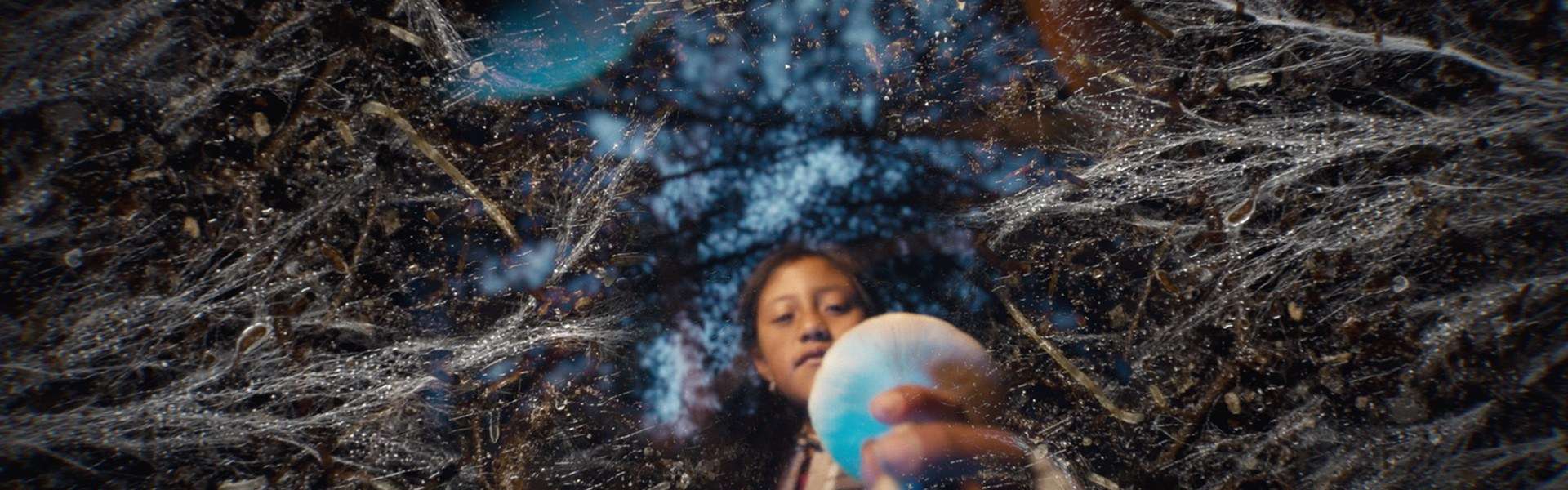
We follow two young female scientists, Lis and Juli, who come from Zapotec mushroom-gathering communities in Mexico and work in mycology (which comes from the word mycelium, meaning fungi), examining how they straddle these two worlds. Described as ‘an immersive sci-fi documentary’, the women’s lives are filmed bruised with shadow and the occasional flash of light, and intercut with eerie, roaming shots of the undergrowth and golden swirls of spreading spores, as well as with a chorus of breathy voices that represent the mushrooms talking about what they need to live. In other words, what DAUGHTERS OF THE FOREST says, is this: everything is interconnected.
Portillo Padua blurs the boundaries between the personal and the academic. In one sequence, we see the women bent over a microscope, their faces cast in the candle-like amber light of a Bunsen Burner, in another they tearfully read out the dedications in their research to members of their family. The film pulls on the tension between the ancestral and the institutional to question our hierarchical understanding of knowledge, who gets access to it, whose is valued, and how we can ensure its preservation.
The film’s main antagonist, seemingly the loggers, loom on the periphery, appearing only in the low rumble of faceless trucks, and the burnt remnants of what they leave behind. These act in stark contrast to the shots of grandmother, granddaughter, and great-grandson winding their way through the forest, wicker baskets in hand. On the surface, it looks one step short of a fairytale, but the story stresses that no hero is coming to save them, and the only thing that will help is coming together. Because in the end, there are no big bad wolves, only people, and the decisions they make, which will determine the fate of not only the forest and its mushrooms, but the future of life on Earth as a whole.
DAUGHTERS OF THE FOREST is thematically rich, and in trying to cover so much, it can at times stray into feeling slightly contrived, and like there isn’t much room to get to know the people as individuals. But that is, to some degree, the whole point. In zooming through the forest, and the things inside and connected to it, Portillo Padua gives us a quietly striking overview of a whole network of people and plants, arguing no one thing can be disentangled from any other, offering an inventive and tender portrait of a community at a crossroads, which works hard to enliven the documentary form.
The Holy Saint, one of the mushrooms featured most prominently in the film, is consumed ritualistically, and believed to tell people when they will die. But in making people more aware of their own mortality, counterintuitively, as Juli says, it can also show them how to live. Yes, DAUGHTERS OF THE FOREST is about mushrooms, but it is also as far-reaching as the mycelium itself, asking big questions about power, life after loss, and what it means to survive in the face of all odds. It’s enough to make even a staunch mushroom hater open their mind. Just don’t make me eat any, please. Well, unless it’s going to tell me when I’m going to die.