
By Daniella Adetoye
In BAAB, Emirati filmmaker Nayla Al Khaja turns the familiar conventions of horror into an exploration of grief, asking what happens when the past refuses to stay buried and whether some doors are better left unopened.
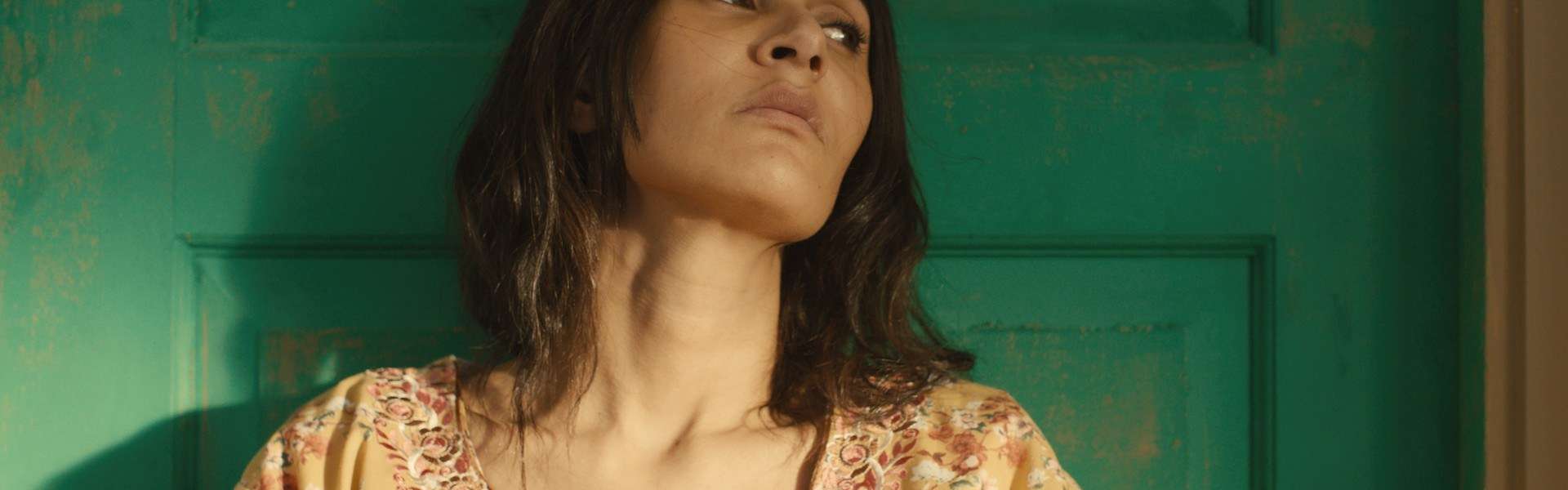
Following the death of her twin sister, Nisma, Wahida (Shaimaa El Fadul) finds herself trapped between the demands of everyday life and a loss she cannot make sense of. Struggling with persistent tinnitus, she discovers cassette tapes hidden behind a mysterious green door in her family home. The recordings send her searching for answers in the mountains of Ras Al-Khaimah, where the distinction between memory, hallucination and something more sinister begins to dissolve.
BAAB’s most compelling achievement is its sound design. The persistent ringing in Wahida’s ear reflects the intrusive physical presence of grief as something that cannot simply be ignored. Through an overlapping, constantly evolving soundscape, ordinary sounds become threatening whilst silence grows uncomfortable, drawing the audience into Wahida’s increasingly fractured perception of the world. The score, composed by the acclaimed R. Rahman works with Krishnan Subramanian’s sound design to create an atmosphere in which the quietest moments carry the possibility of something terrible bringing a further dimension to the film’s unsettling atmosphere.
Visually, the film contrasts the claustrophobia of domestic life with the imposing landscape of the mountains. As Wahida’s search progresses, Al Khaja’s striking, hallucinatory imagery makes the world feel increasingly strange and unstable, blurring the boundaries between the tangible and the imagined. The green door itself becomes an intriguing symbol of the boundary between what a family remembers and what it would rather conceal. Yet the film’s domestic tensions are arguably as unsettling as its supernatural elements. Through Wahida’s relationship with her mother, the performances convey an undercurrent of emotional tension and unease, as BAAB gestures towards the expectations placed on women as wives, mothers and daughters, suggesting that grief does not exist in isolation from the roles society demands they perform.
However, BAAB’s commitment to ambiguity is both its strength and its weakness. Its gradual blurring of reality and fantasy makes Wahida’s experience disorientating in an effective way, but the mystery occasionally feels obscure, with some of the film’s wider ideas about gender and marriage lingering without quite coalescing into a satisfying whole. Viewers hoping for the neat resolution of a conventional thriller may find themselves frustrated.
Nevertheless, BAAB is an intriguing addition to contemporary Emirati cinema. As the second feature from the UAE’s first female feature-film director, it is significant for the space it creates for a woman’s interior life to occupy the centre of a genre film. Al Khaja may not unlock every mystery she introduces, but her exploration of grief leaves a door open long after the film ends.