Nuisance Bear Reel Voices Review
By Leona Suri

By Leona Suri
Directed by Jack Weisman and Gabriela Osio Vanden, NUISANCE BEAR explores the tense relationship between humans and polar bears in Churchill, Manitoba and Arviat, Nunavut. Expanding on the filmmakers’ acclaimed 2021 short, which followed a polar bear without narration, the documentary now introduces the voice of Inuit storyteller Mike Tunalaaq Gibbons. His poetic narration reveals the complex histories and conflicting perspectives behind the bear’s designation as a nuisance in two very different communities.
The film opens on a bundle of white fur nestled against the snowy landscape: polar bear cubs enveloped in their mother’s protective embrace. This tender image is abruptly juxtaposed with a shot of a swarm of photographers, with faces obscured behind an arsenal of cameras. It is a striking contrast that immediately raises the documentary’s central question of who, exactly, is the nuisance?
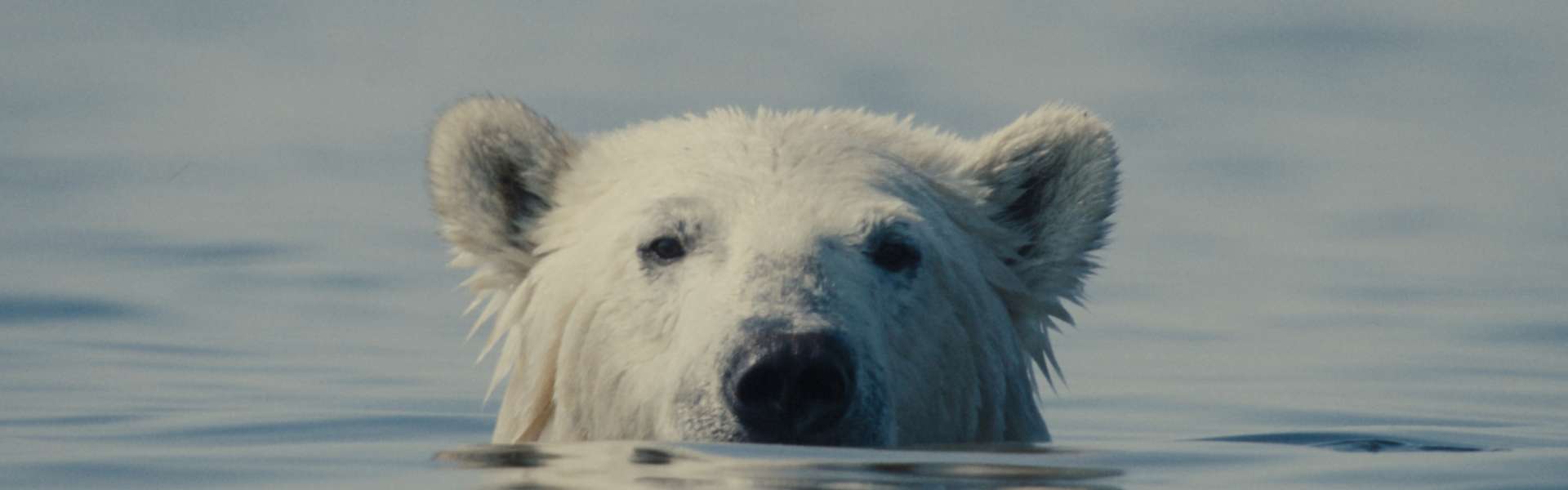
We follow the journey of a lone bear, frequently filmed from above, dwarfed by the vast landscapes that surround him. Whether swimming exhaustedly through open water, trudging across seemingly endless stretches of land, or pawing through a sprawling rubbish heap, he appears painfully small against his surroundings. Expansive aerial shots are interspersed with moments of extraordinary intimacy. Close- ups of the bear’s face allow our furry subject to communicate without words. His exhaustion, curiosity and vulnerability to speak for themselves.
Perhaps the documentary’s most compelling achievement lies in the profound relationship it establishes between its two main subjects: the polar bear, and Mike Tunalaaq Gibbons. The camera returns repeatedly to close-ups of Gibbons, whose thoughtful, expressive gaze seems to mirror that of the animal. Both faces etch out a poignant story, their expressions painted by their complicated relationships to the land they call home.
Through Gibbons’ narration we are introduced to an Inuit understanding of the natural world as intertwined with humanity. He speaks of humans and bears as connected, recounting an Inuit legend of a creature able to transform from bear to human and back again. This perspective is placed in sharp contrast with the commentary of a tour guide from Churchill’s Lazy Bear Expeditions. Where Gibbons speaks with a poetic gravity that suggests knowledge passed down through generations, the guide’s observations are informal and comical. This juxtaposition reveals two markedly different ways of relating to the bear: as a being deserving of reverence and understanding, or as a spectacle to be captured through the screen of an iPhone and later consumed on Instagram.
Both humans and polar bears are formidable apex predators, yet NUISANCE BEAR makes excruciatingly clear how disproportionate the balance of power between us has become. Sound is integral to communicate this imbalance in the documentary. The Arctic’s natural soundscape is repeatedly disrupted by the mechanical intrusions of human activity: buzzing vehicle engines, the relentless whirring of a helicopter, the sharp crack of gunfire, and the incessant clicking of camera shutters. These sounds feel abrasive, causing the documentary’s title to take on an increasingly bitter irony. It is humanity that swarms the animal like flies, relentlessly pursuing, disturbing and displacing him. Who, then, is the real pest?
The sound design does more than expose the violence of human intrusion. It also draws us into the bear’s experience. At moments of vulnerability, surrounding noise becomes muffled and indistinct. The soundscape narrows to the bear’s laboured breathing and the heavy rhythm of his heartbeat. Suddenly, the bear is more than just an object of observation, he is a subject whose fear and exhaustion we are invited to feel. This is emphasised by a series of dreamlike sequences, made up of blurred colourful images: a beluga whale beneath the water, the wind sweeping across the ice, the bear drenched in the colour red.
This shift in perspective is what makes NUISANCE BEAR so much more than a conventional wildlife documentary. By treating its subjects as equals, Weisman and Vanden challenge the assumption that humans stand apart from, or above the natural world. In drawing parallels between the bear and the Inuit community, both native to the land, the question of who belongs and who is deemed a nuisance takes on a deeper resonance.